#include <stdbool.h>#include <stddef.h>#include <stdint.h>#include <tgmath.h>#include "ic_macros/assert_constant.h"#include "ic_macros/assert_type.h"#include "ic_macros/pragma_message.h"#include "zephyr/build_assert.h"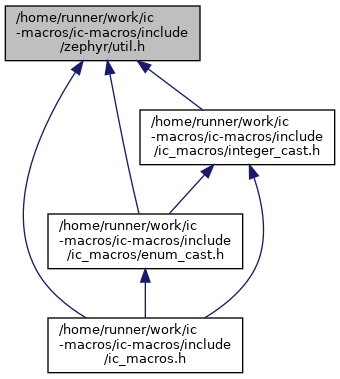
Go to the source code of this file.
Macros | |
| #define | IC_NUM_BITS(t) (sizeof(t) * 8) |
| Number of bits that make up a type. More... | |
| #define | IC_POINTER_TO_UINT(x) ((uintptr_t) (x)) |
Cast x, a pointer, to an unsigned integer. More... | |
| #define | IC_UINT_TO_POINTER(x) ((void *) (uintptr_t) (x)) |
Cast x, an unsigned integer, to a void*. More... | |
| #define | IC_POINTER_TO_INT(x) ((intptr_t) (x)) |
Cast x, a pointer, to a signed integer. More... | |
| #define | IC_INT_TO_POINTER(x) ((void *) (intptr_t) (x)) |
Cast x, a signed integer, to a void*. More... | |
| #define | IC_GENMASK32(h, l) (((~0UL) - (1UL << (l)) + 1) & (~0UL >> (32UL - 1 - (h)))) |
Create a contiguous bitmask starting at bit position l and ending at position h. More... | |
| #define | IC_GENMASK64(h, l) (((~0ULL) - (1ULL << (l)) + 1) & (~0ULL >> (64ULL - 1 - (h)))) |
Create a contiguous 64-bit bitmask starting at bit position l and ending at position h. More... | |
| #define | IC_G_LSB_GET(value) ((value) & -(value)) |
Only use in global scope; extract the Least Significant Bit from value. More... | |
| #define | IC_LSB_GET(value) _IC_MAKE_SINGLE_EVAL_1(value) |
Extract the Least Significant Bit from value. More... | |
| #define | IC_G_FIELD_GET(mask, value) (((value) & (mask)) / IC_LSB_GET(mask)) |
Only use in global scope; extract a bitfield element from value corresponding to the field mask mask. More... | |
| #define | IC_FIELD_GET(mask, value) _IC_MAKE_SINGLE_EVAL_2(IC_G_FIELD_GET, mask, value) |
Extract a bitfield element from value corresponding to the field mask mask. More... | |
| #define | IC_G_FIELD_PREP(mask, value) (((value) * IC_LSB_GET(mask)) & (mask)) |
Only use in global scope; prepare a bitfield element using value with mask representing its field position and width. The result should be combined with other fields using a logical OR. More... | |
| #define | IC_FIELD_PREP(mask, value) _IC_MAKE_SINGLE_EVAL_2(IC_G_FIELD_PREP, mask, value) |
Prepare a bitfield element using value with mask representing its field position and width. The result should be combined with other fields using a logical OR. More... | |
| #define | IC_ZERO_OR_COMPILE_ERROR(cond) ((int) sizeof(char[1 - 2 * !(cond)]) - 1) |
0 if cond is true-ish; causes a compile error otherwise. More... | |
| #define | IC_ARRAY_LENGTH(array) (unsigned int) (_IC_IS_ARRAY(array) + (sizeof(array) / sizeof((array)[0]))) |
Number of elements in the given array; the "length". More... | |
| #define | IC_ARRAY_SIZE(array) (size_t)(_IC_IS_ARRAY(array) + sizeof(array)) |
Size of the given array in 8-bit bytes. More... | |
| #define | IC_IS_ARRAY_ELEMENT(array, ptr) |
Whether ptr is an element of array. More... | |
| #define | IC_ARRAY_INDEX(array, ptr) IC_IS_ARRAY_ELEMENT(array, ptr) ? (__typeof__((array)[0]) *) (ptr) - (array) : -1 |
Index of ptr within array. More... | |
| #define | IC_PART_OF_ARRAY(array, ptr) |
Check if a pointer ptr lies within array. More... | |
| #define | IC_ARRAY_INDEX_FLOOR(array, ptr) |
Array-index of ptr within array, rounded down. More... | |
| #define | IC_SAME_TYPE(a, b) __builtin_types_compatible_p(__typeof__(a), __typeof__(b)) |
| Validate if two entities have a compatible type. More... | |
| #define | IC_CONTAINER_OF(ptr, type, field) |
| Get a pointer to a structure containing the element. More... | |
| #define | IC_G_IROUND_UP(x, align) |
Only use in global scope; value of integer x rounded up to the next multiple of align. More... | |
| #define | IC_IROUND_UP(x, align) _IC_MAKE_SINGLE_EVAL_2(IC_G_IROUND_UP, x, align) |
Value of integer x rounded up to the next multiple of align. More... | |
| #define | IC_G_IROUND_DOWN(x, align) (((unsigned long) (x) / (unsigned long) (align)) * (unsigned long) (align)); |
Only use in global scope; value of integer x rounded down to the next multiple of align. More... | |
| #define | IC_IROUND_DOWN(x, align) _IC_MAKE_SINGLE_EVAL_2(IC_IROUND_DOWN, x, align) |
Value of integer x rounded down to the next multiple of align. More... | |
| #define | IC_WB_UP(x) IC_IROUND_UP(x, sizeof(void *)) |
Value of x rounded up to the next word boundary. More... | |
| #define | IC_WB_DN(x) IC_IROUND_DOWN(x, sizeof(void *)) |
Value of x rounded down to the previous word boundary. More... | |
| #define | IC_G_CEIL(x) ceil(x) |
| Only use in global scope; compile-time floating point ceiling of f32 (float), f64 (double), & f128 (long double). More... | |
| #define | IC_CEIL(x) |
| Compile-time floating point ceiling of f32 (float), f64 (double), & f128 (long double). More... | |
| #define | IC_G_FLOOR(x) floor(x) |
| Only use in global scope; compile-time floating point floor of f32 (float), f64 (double), & f128 (long double). More... | |
| #define | IC_FLOOR(x) |
| Compile-time floating point floor of f32 (float), f64 (double), & f128 (long double). More... | |
| #define | IC_G_ROUND(x) (__typeof__(x)) (int64_t) ((x) + ((x) >= 0 ? 0.5 : -0.5)) |
| Only use in global scope; round of f32 (float), f64 (double), & f128 (long double). More... | |
| #define | IC_ROUND(x) |
| Round of f32 (float), f64 (double), & f128 (long double). More... | |
| #define | IC_G_DIV_ROUND_UP(n, d) (((n) + (d) -1) / (d)) |
| Only use in global scope; divide and round up. More... | |
| #define | IC_DIV_ROUND_UP(n, d) _IC_MAKE_SINGLE_EVAL_2(IC_G_DIV_ROUND_UP, n, d) |
| Divide and round up. More... | |
| #define | IC_G_DIV_ROUND_CLOSEST(n, d) ((((n) < 0) ^ ((d) < 0)) ? ((n) - ((d) / 2)) / (d) : ((n) + ((d) / 2)) / (d)) |
| Only use in global scope; divide and round to the nearest integer. More... | |
| #define | IC_DIV_ROUND_CLOSEST(n, d) _IC_MAKE_SINGLE_EVAL_2(IC_G_DIV_ROUND_CLOSEST, n, d) |
| Divide and round to the nearest integer. More... | |
| #define | IC_G_MAX(a, b) (((a) > (b)) ? (a) : (b)) |
| Only use in global scope; obtain the maximum of two values. More... | |
| #define | IC_MAX(a, b) _IC_MAKE_SINGLE_EVAL_2(IC_G_MAX, a, b) |
| Obtain the maximum of two values. More... | |
| #define | IC_G_MIN(a, b) (((a) < (b)) ? (a) : (b)) |
| Only use in global scope; obtain the minimum of two values. More... | |
| #define | IC_MIN(a, b) _IC_MAKE_SINGLE_EVAL_2(IC_G_MIN, a, b) |
| Obtain the minimum of two values. More... | |
| #define | IC_G_CLAMP(val, low, high) (((val) <= (low)) ? (low) : IC_MIN(val, high)) |
| Only use in global scope; clamp a value to a given range. More... | |
| #define | IC_CLAMP(val, low, high) _IC_MAKE_SINGLE_EVAL_3(IC_G_CLAMP, val, low, high) |
| Clamp a value to a given range. More... | |
| #define | IC_G_IN_RANGE(val, min, max) ((__typeof__(val)) -1) > 0 ? ((val) <= (max)) : ((val) >= (min) && (val) <= (max)) |
| Only use in global scope; checks if a value is within range. More... | |
| #define | IC_IN_RANGE(val, min, max) _IC_MAKE_SINGLE_EVAL_3(IC_G_IN_RANGE, val, min, max) |
| Checks if a value is within range. More... | |
| #define | IC_G_ILOG2(x) (sizeof(__typeof__(x)) > 4 ? (64 - __builtin_clzll(x) - 1) : (32 - __builtin_clz(x) - 1)) |
| Only use in global scope; compute integer value of log2(x) More... | |
| #define | IC_ILOG2(x) |
| Compute integer value log2(x) More... | |
| #define | IC_G_LOG2CEIL(x) (x) < 1 ? 0 : IC_G_ILOG2((x) -1) + 1 |
| Only use in global scope; compute ceil(log2(x)) More... | |
| #define | IC_LOG2CEIL(x) _IC_MAKE_SINGLE_EVAL_1(IC_G_LOG2CEIL, x) |
| Compute ceil(log2(x)) More... | |
| #define | IC_G_NHPOT(x) ((x) < 1 ? 1 : ((x) > (1ULL << 63) ? 0 : 1ULL << IC_G_LOG2CEIL(x))) |
| Only use in global scope; compute next highest power of two. More... | |
| #define | IC_NHPOT(x) _IC_MAKE_SINGLE_EVAL_1(IC_G_NHPOT, x) |
| Compute next highest power of two. More... | |
| #define | IC_G_POW2_CEIL(x) ((x) <= 2UL ? (x) : (1UL << (8 * sizeof(long) - __builtin_clzl((x) -1)))) |
| Only use in global scope; calculate power of two ceiling for some nonzero value. More... | |
| #define | IC_POW2_CEIL(x) _IC_MAKE_SINGLE_EVAL_1(IC_G_POW2_CEIL, x) |
| Calculate power of two ceiling for some nonzero value. More... | |
| #define | IC_G_IS_POW2(x) (((x) != 0) && (((x) & ((x) -1)) == 0)) |
| Only use in global scope; check whether or not a value is a power of 2. More... | |
| #define | IC_IS_POW2(x) _IC_MAKE_SINGLE_EVAL_1(IC_G_IS_POW2) |
| Check whether or not a value is a power of 2. More... | |
| #define | IC_BIT(n) (1UL << (n)) |
Unsigned integer with bit position n set. More... | |
| #define | IC_BIT64(n) (1ULL << (n)) |
64-bit unsigned integer with bit position n set. More... | |
| #define | IC_G_WRITE_BIT(var, bit, set) (set) ? ((var) | IC_BIT(bit)) : ((var) & ~IC_BIT(bit)) |
| Only use in global scope; set or clear a bit depending on a boolean value. More... | |
| #define | IC_WRITE_BIT(var, bit, set) _IC_MAKE_SINGLE_EVAL_3(IC_G_WRITE_BIT, var, bit, set) |
| Set or clear a bit depending on a boolean value. More... | |
| #define | IC_BIT_MASK(n) (IC_BIT(n) - 1UL) |
Bit mask with bits 0 through n-1 (inclusive) set, or 0 if n is 0. More... | |
| #define | IC_BIT64_MASK(n) (IC_BIT64(n) - 1ULL) |
64-bit bit mask with bits 0 through n-1 (inclusive) set, or 0 if n is 0. More... | |
| #define | IC_G_IS_SHIFTED_BIT_MASK(m, s) (!(((m) >> (s)) & (((m) >> (s)) + 1U))) |
| Only use in global scope; check if bits are set continuously from the specified bit. More... | |
| #define | IC_IS_SHIFTED_BIT_MASK(m, s) _IC_MAKE_SINGLE_EVAL_2(IC_G_IS_SHIFTED_BIT_MASK, m, s) |
| Check if bits are set continuously from the specified bit. More... | |
| #define | IC_G_IS_BIT_MASK(m) IC_G_IS_SHIFTED_BIT_MASK(m, 0) |
| Only use in global scope; check if bits are set continuously from the LSB. More... | |
| #define | IC_IS_BIT_MASK(m) IC_IS_SHIFTED_BIT_MASK(m, 0) |
| Check if bits are set continuously from the LSB. More... | |
| #define | IC_G_BSWAP24(x) (((x) >> 16) & 0x0000FF) | (((x) >> 00) & 0x00FF00) | ((((x) & 0x0000FF) << 16)) |
| Only use in global scope; 24-bit byte swap. More... | |
| #define | IC_BSWAP24(x) _IC_MAKE_SINGLE_EVAL_1(IC_G_BSWAP24, x) |
| 24-bit byte swap. More... | |
Macro Definition Documentation
◆ IC_ARRAY_INDEX
| #define IC_ARRAY_INDEX | ( | array, | |
| ptr | |||
| ) | IC_IS_ARRAY_ELEMENT(array, ptr) ? (__typeof__((array)[0]) *) (ptr) - (array) : -1 |
Index of ptr within array.
This macro will return -1 when ptr does not fall into the range of array or when ptr is not aligned to an array-element boundary of array.
In C, passing a pointer as array causes a compile error.
- Parameters
-
array the array in question ptr pointer to an element of array
- Returns
- -1 on error, or the array index of
ptrwithinarray, on success
◆ IC_ARRAY_INDEX_FLOOR
| #define IC_ARRAY_INDEX_FLOOR | ( | array, | |
| ptr | |||
| ) |
Array-index of ptr within array, rounded down.
This macro behaves much like IC_ARRAY_INDEX with the notable difference that it accepts any ptr in the range of array rather than exclusively a ptr aligned to an array-element boundary of array.
This macro will return -1 when ptr does not fall into the range of array.
In C, passing a pointer as array causes a compile error.
- Parameters
-
array the array in question ptr pointer to an element of array
- Returns
- -1 on error, or the array index of
ptrwithinarray, on success
◆ IC_ARRAY_LENGTH
| #define IC_ARRAY_LENGTH | ( | array | ) | (unsigned int) (_IC_IS_ARRAY(array) + (sizeof(array) / sizeof((array)[0]))) |
◆ IC_ARRAY_SIZE
| #define IC_ARRAY_SIZE | ( | array | ) | (size_t)(_IC_IS_ARRAY(array) + sizeof(array)) |
◆ IC_BIT
| #define IC_BIT | ( | n | ) | (1UL << (n)) |
◆ IC_BIT64
| #define IC_BIT64 | ( | n | ) | (1ULL << (n)) |
◆ IC_BIT64_MASK
| #define IC_BIT64_MASK | ( | n | ) | (IC_BIT64(n) - 1ULL) |
◆ IC_BIT_MASK
| #define IC_BIT_MASK | ( | n | ) | (IC_BIT(n) - 1UL) |
◆ IC_BSWAP24
| #define IC_BSWAP24 | ( | x | ) | _IC_MAKE_SINGLE_EVAL_1(IC_G_BSWAP24, x) |
◆ IC_CEIL
| #define IC_CEIL | ( | x | ) |
Compile-time floating point ceiling of f32 (float), f64 (double), & f128 (long double).
Useful for casting to an integer: #define ROUNDED_UP IC_CEIL(MY_FLOATING_POINT_NUMBER)
- Note
- Generates compile error if x is not a compile-time constant; use ceil(x) from <tgmath.h>.
- Parameters
-
x floating point number to ceiling.
- Returns
- the output of ceil(x); same type as the argument
◆ IC_CLAMP
| #define IC_CLAMP | ( | val, | |
| low, | |||
| high | |||
| ) | _IC_MAKE_SINGLE_EVAL_3(IC_G_CLAMP, val, low, high) |
◆ IC_CONTAINER_OF
| #define IC_CONTAINER_OF | ( | ptr, | |
| type, | |||
| field | |||
| ) |
Get a pointer to a structure containing the element.
Example:
struct foo { int bar; };
struct foo my_foo; int * ptr = &my_foo.bar;
struct foo * container = IC_CONTAINER_OF(ptr, struct foo, bar);
Above, container points at my_foo.
- Parameters
-
ptr pointer to a structure element type name of the type that ptris an element offield the name of the field within the struct ptrpoints to
- Returns
- a pointer to the structure that contains
ptr
◆ IC_DIV_ROUND_CLOSEST
| #define IC_DIV_ROUND_CLOSEST | ( | n, | |
| d | |||
| ) | _IC_MAKE_SINGLE_EVAL_2(IC_G_DIV_ROUND_CLOSEST, n, d) |
Divide and round to the nearest integer.
Example:
- Parameters
-
n Numerator. d Denominator.
- Returns
- The result of
n/d, rounded to the nearest integer.
- Note
- Expressions are only evaluated once.
◆ IC_DIV_ROUND_UP
| #define IC_DIV_ROUND_UP | ( | n, | |
| d | |||
| ) | _IC_MAKE_SINGLE_EVAL_2(IC_G_DIV_ROUND_UP, n, d) |
Divide and round up.
Example:
- Parameters
-
n Numerator. d Denominator.
- Returns
- The result of
n/d, rounded up.
- Note
- Expressions are only evaluated once.
◆ IC_FIELD_GET
| #define IC_FIELD_GET | ( | mask, | |
| value | |||
| ) | _IC_MAKE_SINGLE_EVAL_2(IC_G_FIELD_GET, mask, value) |
◆ IC_FIELD_PREP
| #define IC_FIELD_PREP | ( | mask, | |
| value | |||
| ) | _IC_MAKE_SINGLE_EVAL_2(IC_G_FIELD_PREP, mask, value) |
◆ IC_FLOOR
| #define IC_FLOOR | ( | x | ) |
Compile-time floating point floor of f32 (float), f64 (double), & f128 (long double).
Useful for casting to an integer: #define ROUNDED_DOWN IC_FLOOR(MY_FLOATING_POINT_NUMBER)
- Note
- Generates compile error if x is not a compile-time constant; use floor(x) from <tgmath.h>.
- Parameters
-
x floating point number to floor.
- Returns
- the output of floor(x); same type as the argument
◆ IC_G_BSWAP24
| #define IC_G_BSWAP24 | ( | x | ) | (((x) >> 16) & 0x0000FF) | (((x) >> 00) & 0x00FF00) | ((((x) & 0x0000FF) << 16)) |
◆ IC_G_CEIL
| #define IC_G_CEIL | ( | x | ) | ceil(x) |
Only use in global scope; compile-time floating point ceiling of f32 (float), f64 (double), & f128 (long double).
Useful for casting to an integer: #define ROUNDED_UP IC_CEIL(MY_FLOATING_POINT_NUMBER)
- Parameters
-
x floating point number to ceiling.
- Returns
- the output of ceil(x); same type as the argument
◆ IC_G_CLAMP
| #define IC_G_CLAMP | ( | val, | |
| low, | |||
| high | |||
| ) | (((val) <= (low)) ? (low) : IC_MIN(val, high)) |
◆ IC_G_DIV_ROUND_CLOSEST
| #define IC_G_DIV_ROUND_CLOSEST | ( | n, | |
| d | |||
| ) | ((((n) < 0) ^ ((d) < 0)) ? ((n) - ((d) / 2)) / (d) : ((n) + ((d) / 2)) / (d)) |
Only use in global scope; divide and round to the nearest integer.
Example:
- Parameters
-
n Numerator. d Denominator.
- Returns
- The result of
n/d, rounded to the nearest integer.
◆ IC_G_DIV_ROUND_UP
| #define IC_G_DIV_ROUND_UP | ( | n, | |
| d | |||
| ) | (((n) + (d) -1) / (d)) |
Only use in global scope; divide and round up.
Example:
- Parameters
-
n Numerator. d Denominator.
- Returns
- The result of
n/d, rounded up.
◆ IC_G_FIELD_GET
| #define IC_G_FIELD_GET | ( | mask, | |
| value | |||
| ) | (((value) & (mask)) / IC_LSB_GET(mask)) |
◆ IC_G_FIELD_PREP
| #define IC_G_FIELD_PREP | ( | mask, | |
| value | |||
| ) | (((value) * IC_LSB_GET(mask)) & (mask)) |
◆ IC_G_FLOOR
| #define IC_G_FLOOR | ( | x | ) | floor(x) |
Only use in global scope; compile-time floating point floor of f32 (float), f64 (double), & f128 (long double).
Useful for casting to an integer: #define ROUNDED_DOWN IC_FLOOR(MY_FLOATING_POINT_NUMBER)
- Note
- Generates compile error if x is not a compile-time constant; use floor(x) from <tgmath.h>.
- Parameters
-
x floating point number to floor.
- Returns
- the output of floor(x); same type as the argument
◆ IC_G_ILOG2
| #define IC_G_ILOG2 | ( | x | ) | (sizeof(__typeof__(x)) > 4 ? (64 - __builtin_clzll(x) - 1) : (32 - __builtin_clz(x) - 1)) |
◆ IC_G_IN_RANGE
| #define IC_G_IN_RANGE | ( | val, | |
| min, | |||
| max | |||
| ) | ((__typeof__(val)) -1) > 0 ? ((val) <= (max)) : ((val) >= (min) && (val) <= (max)) |
◆ IC_G_IROUND_DOWN
| #define IC_G_IROUND_DOWN | ( | x, | |
| align | |||
| ) | (((unsigned long) (x) / (unsigned long) (align)) * (unsigned long) (align)); |
◆ IC_G_IROUND_UP
| #define IC_G_IROUND_UP | ( | x, | |
| align | |||
| ) |
◆ IC_G_IS_BIT_MASK
| #define IC_G_IS_BIT_MASK | ( | m | ) | IC_G_IS_SHIFTED_BIT_MASK(m, 0) |
◆ IC_G_IS_POW2
| #define IC_G_IS_POW2 | ( | x | ) | (((x) != 0) && (((x) & ((x) -1)) == 0)) |
◆ IC_G_IS_SHIFTED_BIT_MASK
| #define IC_G_IS_SHIFTED_BIT_MASK | ( | m, | |
| s | |||
| ) | (!(((m) >> (s)) & (((m) >> (s)) + 1U))) |
◆ IC_G_LOG2CEIL
| #define IC_G_LOG2CEIL | ( | x | ) | (x) < 1 ? 0 : IC_G_ILOG2((x) -1) + 1 |
◆ IC_G_LSB_GET
| #define IC_G_LSB_GET | ( | value | ) | ((value) & -(value)) |
◆ IC_G_MAX
| #define IC_G_MAX | ( | a, | |
| b | |||
| ) | (((a) > (b)) ? (a) : (b)) |
◆ IC_G_MIN
| #define IC_G_MIN | ( | a, | |
| b | |||
| ) | (((a) < (b)) ? (a) : (b)) |
◆ IC_G_NHPOT
| #define IC_G_NHPOT | ( | x | ) | ((x) < 1 ? 1 : ((x) > (1ULL << 63) ? 0 : 1ULL << IC_G_LOG2CEIL(x))) |
◆ IC_G_POW2_CEIL
| #define IC_G_POW2_CEIL | ( | x | ) | ((x) <= 2UL ? (x) : (1UL << (8 * sizeof(long) - __builtin_clzl((x) -1)))) |
◆ IC_G_ROUND
| #define IC_G_ROUND | ( | x | ) | (__typeof__(x)) (int64_t) ((x) + ((x) >= 0 ? 0.5 : -0.5)) |
Only use in global scope; round of f32 (float), f64 (double), & f128 (long double).
Useful for casting to an integer: uint32_t const ROUNDED = (uint32_t) IC_G_ROUND(MY_FLOATING_POINT_NUMBER)
- Note
- Tie-breaks .5 (1/2) AWAY FROM ZERO for positive and negative numbers, e.g. 0.5 -> 1 and -0.5 -> -1.
- Parameters
-
x floating point number to round.
- Returns
- The rounded number
◆ IC_G_WRITE_BIT
◆ IC_GENMASK32
| #define IC_GENMASK32 | ( | h, | |
| l | |||
| ) | (((~0UL) - (1UL << (l)) + 1) & (~0UL >> (32UL - 1 - (h)))) |
◆ IC_GENMASK64
| #define IC_GENMASK64 | ( | h, | |
| l | |||
| ) | (((~0ULL) - (1ULL << (l)) + 1) & (~0ULL >> (64ULL - 1 - (h)))) |
◆ IC_ILOG2
| #define IC_ILOG2 | ( | x | ) |
Compute integer value log2(x)
- Parameters
-
x An unsigned integral value to compute logarithm of (positive only)
- Returns
- log2(x) or -1 if x < 1
◆ IC_IN_RANGE
| #define IC_IN_RANGE | ( | val, | |
| min, | |||
| max | |||
| ) | _IC_MAKE_SINGLE_EVAL_3(IC_G_IN_RANGE, val, min, max) |
◆ IC_INT_TO_POINTER
| #define IC_INT_TO_POINTER | ( | x | ) | ((void *) (intptr_t) (x)) |
◆ IC_IROUND_DOWN
| #define IC_IROUND_DOWN | ( | x, | |
| align | |||
| ) | _IC_MAKE_SINGLE_EVAL_2(IC_IROUND_DOWN, x, align) |
◆ IC_IROUND_UP
| #define IC_IROUND_UP | ( | x, | |
| align | |||
| ) | _IC_MAKE_SINGLE_EVAL_2(IC_G_IROUND_UP, x, align) |
◆ IC_IS_ARRAY_ELEMENT
| #define IC_IS_ARRAY_ELEMENT | ( | array, | |
| ptr | |||
| ) |
Whether ptr is an element of array.
This macro can be seen as a slightly stricter version of PART_OF_ARRAY in that it also ensures that ptr is aligned to an array-element boundary of array.
In C, passing a pointer as array causes a compile error.
- Parameters
-
array the array in question ptr the pointer to check
- Returns
- 1 if
ptris part ofarray, 0 otherwise
◆ IC_IS_BIT_MASK
| #define IC_IS_BIT_MASK | ( | m | ) | IC_IS_SHIFTED_BIT_MASK(m, 0) |
◆ IC_IS_POW2
| #define IC_IS_POW2 | ( | x | ) | _IC_MAKE_SINGLE_EVAL_1(IC_G_IS_POW2) |
◆ IC_IS_SHIFTED_BIT_MASK
| #define IC_IS_SHIFTED_BIT_MASK | ( | m, | |
| s | |||
| ) | _IC_MAKE_SINGLE_EVAL_2(IC_G_IS_SHIFTED_BIT_MASK, m, s) |
◆ IC_LOG2CEIL
| #define IC_LOG2CEIL | ( | x | ) | _IC_MAKE_SINGLE_EVAL_1(IC_G_LOG2CEIL, x) |
◆ IC_LSB_GET
| #define IC_LSB_GET | ( | value | ) | _IC_MAKE_SINGLE_EVAL_1(value) |
◆ IC_MAX
| #define IC_MAX | ( | a, | |
| b | |||
| ) | _IC_MAKE_SINGLE_EVAL_2(IC_G_MAX, a, b) |
◆ IC_MIN
| #define IC_MIN | ( | a, | |
| b | |||
| ) | _IC_MAKE_SINGLE_EVAL_2(IC_G_MIN, a, b) |
◆ IC_NHPOT
| #define IC_NHPOT | ( | x | ) | _IC_MAKE_SINGLE_EVAL_1(IC_G_NHPOT, x) |
Compute next highest power of two.
Equivalent to 2^ceil(log2(x))
- Note
- This macro expands its argument multiple times (to permit use in constant expressions), which must not have side effects.
- Parameters
-
x An unsigned integral value
- Returns
- 2^ceil(log2(x)) or 0 if 2^ceil(log2(x)) would saturate 64-bits
◆ IC_NUM_BITS
| #define IC_NUM_BITS | ( | t | ) | (sizeof(t) * 8) |
◆ IC_PART_OF_ARRAY
| #define IC_PART_OF_ARRAY | ( | array, | |
| ptr | |||
| ) |
Check if a pointer ptr lies within array.
In C but not C++, this causes a compile error if array is not an array (e.g. if ptr and array are mixed up).
- Parameters
-
array an array ptr a pointer
- Returns
- 1 if
ptris part ofarray, 0 otherwise
◆ IC_POINTER_TO_INT
| #define IC_POINTER_TO_INT | ( | x | ) | ((intptr_t) (x)) |
◆ IC_POINTER_TO_UINT
| #define IC_POINTER_TO_UINT | ( | x | ) | ((uintptr_t) (x)) |
◆ IC_POW2_CEIL
| #define IC_POW2_CEIL | ( | x | ) | _IC_MAKE_SINGLE_EVAL_1(IC_G_POW2_CEIL, x) |
◆ IC_ROUND
| #define IC_ROUND | ( | x | ) |
Round of f32 (float), f64 (double), & f128 (long double).
Useful for casting to an integer: #define ROUNDED (uint32_t) IC_ROUND(MY_FLOATING_POINT_NUMBER)
- Note
- Generates compile error if x is not a compile-time constant; use round*(x) from <math.h> or <tgmath.h>
- Tie-breaks .5 (1/2) AWAY FROM ZERO for positive and negative numbers, e.g. 0.5 -> 1 and -0.5 -> -1.
- Parameters
-
x floating point number to round.
- Returns
- The rounded number
◆ IC_SAME_TYPE
| #define IC_SAME_TYPE | ( | a, | |
| b | |||
| ) | __builtin_types_compatible_p(__typeof__(a), __typeof__(b)) |
◆ IC_UINT_TO_POINTER
| #define IC_UINT_TO_POINTER | ( | x | ) | ((void *) (uintptr_t) (x)) |
◆ IC_WB_DN
| #define IC_WB_DN | ( | x | ) | IC_IROUND_DOWN(x, sizeof(void *)) |
◆ IC_WB_UP
| #define IC_WB_UP | ( | x | ) | IC_IROUND_UP(x, sizeof(void *)) |
◆ IC_WRITE_BIT
| #define IC_WRITE_BIT | ( | var, | |
| bit, | |||
| set | |||
| ) | _IC_MAKE_SINGLE_EVAL_3(IC_G_WRITE_BIT, var, bit, set) |